A smart device to assist elderly all round the world!
Smart Medicine Reminder
With progressing age most of the bodily functions weaken and shut down, but one thing that gets most affected in elders is their “memory”. Most of the senior citizens combats with forgetfulness which not only contribute to the disorientation and confusion, but also affect their day to day activities.
Almost 9 out of 10 elders are suffering from more than one diseases therefore it is absolutely necessary for them to take medicines. However, due to forgetfulness they miss their dose or forget to take their medicines on time, especially the senior citizens who live alone. The missing dose may not only interrupt their treatment, but in some cases can prove to be fatal. Therefore, it is crucial that not only the patients take their medicine, but they take it on time. This problem has been solved by the Smart Medicine Reminder. The Smart Medicine Reminder enables these patients to take their prescribed dose on time. The device is not only smart as it names suggests but it also portable and extremely easy to use.
The purpose of Smart Medicine Reminder
The purpose of this device was to facilitate the senior citizens which are overwhelmed by technology and are looking for something which can be easily handled and adapted.
How Smart Medicine Reminder works?
The device comes with a buzzer which acts as an alarm. This alarm is set for every 6 hours. which is the standard time for medication. While it buzzes the LED on the device also blinks so that if the patient has hearing disability the blinking LED will notify the patient of med time.
The device has “one single button” that has to be pressed by patient to stop the alarm, after pressing the button the patient has to place their finger on the sensor to get their pulse rate checked. This pulse rate is displayed on the LCD. After the pulse has been taken the LCD notifies the patient that now is the time to take medicine. After 30 mins the devices buzzes again for the second pulse check. When the second pulse rate has been taken the the button has to be pressed which initials the next cycle.
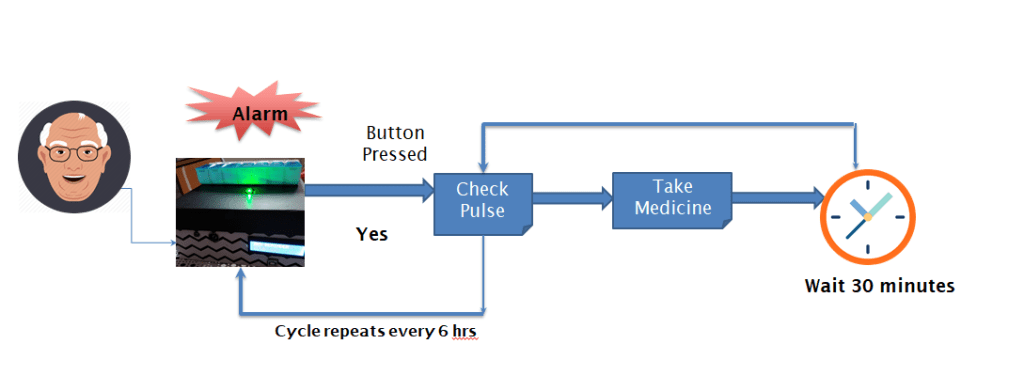
Why patients need their pulse rate checked?
Pulse rate is one of the most frequent diagnostic tools which checks if the patient metabolism is working fine. Especially if the patient is suffering from high/low blood pressure, cholesterol or other cardiac problems. It is imperative for them to see if their pulse rate is within the range. This device enables the patient to check their heart rate without cuffs and stethoscope by just placing the finger on the sensor. The pulse rate is taken twice; once before taking the medicine and then after taking the medicine. After the pulse rate is taken it also tells the patient if their blood pressure was in their normal range through a message on the LCD.
Why pulse rate is taken twice?
Medications have several side effects and most common is the fluctuation in heart rate, the very low or very high heart rate can have serious consequences, if not dealt with on time. Therefore, checking the pulse rate after taking medicine makes sure that the patient is not going under any medicinal side effect. The second pulse rate is taken after 30 mins after the dose time. In these thirty minutes the medicine is metabolized and is in the patient’s bloodstream.


Additional feature
Smart Medicine Reminder has compartmentalized pill dispenser in which patient can place their multiple medicines separately and take them accordingly. The Smart Medicine Reminder comes with a battery but it can also be connected to the adapter.
Design and Implementation
Circuit design
The device is built through very basic components which are easily available and are also economical. As a result the device is not only user-friendly but pocket-friendly as well.
Following components are being used in Smart Medicine Reminder:
- Arduino Uno
- Buzzer
- Pulse Sensor
- LED
- Battery 9V
After the initial circuit design it was simulated and tested through Proteus 8.0.
About Team
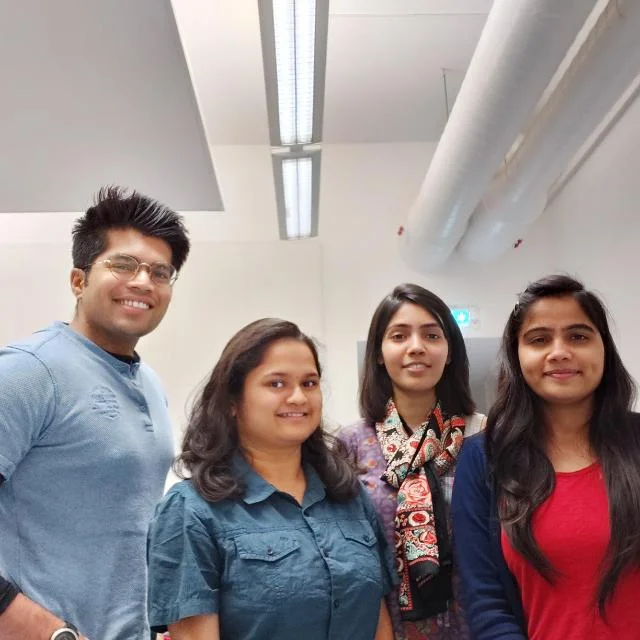
Smart Medicine Reminder prototype is designed and created as part of the course project by four members Shreyas Vinnay oka, Sara Hasan, Rasika Murkar and Meghashree Matti Channaveerappa which are currently enrolled in MSc. Medical System Engineering at OVGU, Magdeburg, Germany.
Follow My Blog
Get new content delivered directly to your inbox.

